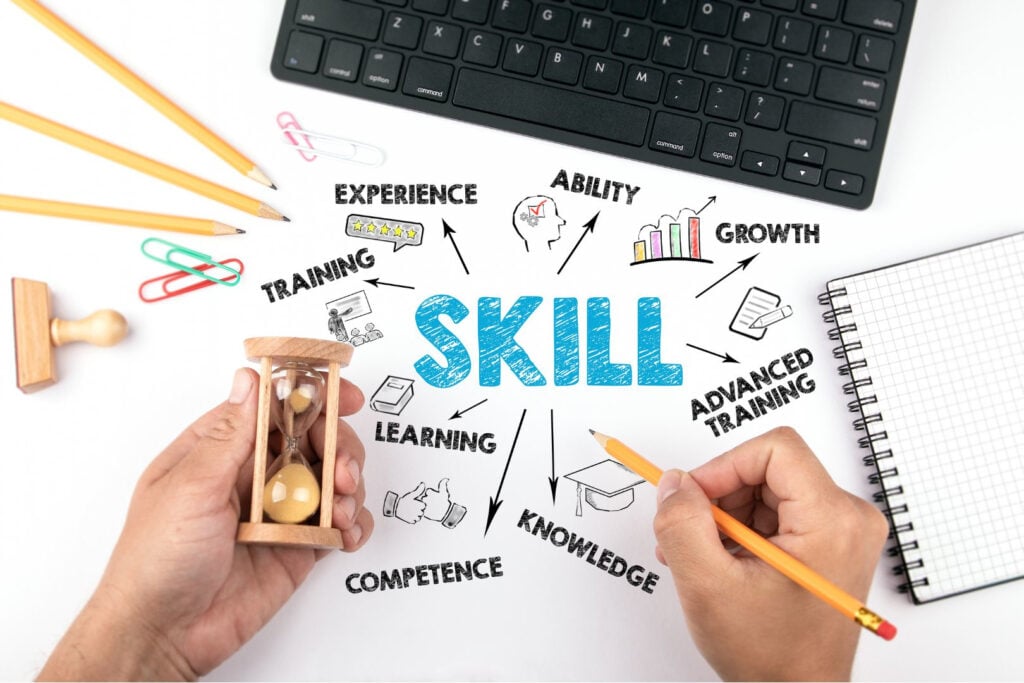
MOE - Learning from Teaching

Two teachers share how their jobs allow them to grow as people and make a positive impact on the lives of others at the same time.

By Colin Lim

“To be a good teacher, you must be a good learner. You cannot stop reading, you cannot stop learning, and you cannot stop questioning,” said Sukhjeet Kaur, a teacher at Swiss Cottage Secondary School. This belief has helped the 29-year-old to improve her teaching methods over the years, from being a self-confessed “dictator” who spoon-fed her students to a facilitator who now encourages them to discover answers for themselves.

Discovering her own career path took Sukhjeet some time. “I had aspirations of becoming a teacher when I was young, but as I grew older, I realised it wasn’t as easy as I thought. So right up to university, I was still undecided,” recalled Sukhjeet.

As an undergraduate, she helped to run programmes catered for youths from a Sikh temple during her school holidays, which made her realise that she could get along well with teenagers. She eventually graduated from NUS in 2000 with a Bachelor’s degree in English Language and English Literature, her favorite subjects which she currently teaches at Swiss Cottage.

Six months before graduation, Sukhjeet applied to be a teacher, which led to a one year stint of contract teaching. It was during this “deciding stage” that she made up her mind to take up teaching as a career.

Sukhjeet then went to the National Institute of Education (NIE) in 2001, where she obtained a Post Graduate Diploma in Education. She joined Swiss Cottage in 2002, where she has been teaching for the last six years. Looking back, she has no regrets about going into teaching, which she chose over other options like journalism.

Inspiring young minds

Sukhjeet explained: “I’ve worked with all sorts of students, from academically strong to weaker ones. But from working with them, and thinking of what kind of pedagogy to use on them within different situations like tuition and youth camps, what really satisfied me the most was knowing that I managed to get the kids to understand concepts and certain things along the way. Even if I write a good piece of prose, it’s still not as satisfying as getting a kid to listen to me, to agree or to disagree or something.”

Indeed, it’s the interaction with her students that Sukhjeet likes most about being a teacher. Describing herself as “a very response-driven” person, she admits that getting her students to respond matters a great deal to her. For instance, she has redesigned lessons for her Normal Technical students by using games and videos, which involve greater interactivity as compared to textbook-dependent methods.

According to Sukhjeet, patience was vital when it came to gaining the trust of her Normal Technical students. She said: “It’s not about coming in and saying ‘I’m your English teacher you better listen to me’ but it’s about winning them over and getting them to respect you. That really needs to be earned, because you need to show them a lot of respect first, which can be difficult because they can be a very trying bunch with a whole range of learning abilities. You have to make sure you don’t step on their toes, and don’t raise any sensitivities.”

In her free time, Sukhjeet helps out at the People’s Association, due to her interest in National Education. “I try to link that back with what I’m doing in Swiss Cottage. In my Literature classes, I’m teaching a local text called “Off Centre”, which you really need to sit down and think about before teaching. So my students and I actually developed our own notes together. They got so enthused by it that they wanted to do all sorts of community work, especially at the IMH (Institute of Mental Health),” shared Sukhjeet.

Other than using innovative teaching methods to educate her students, Sukhjeet is also in charge of the Drama Club. Despite not having a professional coach, the team has done well under the guidance of Sukhjeet and a fellow teacher. She said: “We’ve participated in the Singapore Youth Festival twice. The first year we had a bronze award, and the second year, a silver award. Next year we’re going for gold.”

From trainee to teacher

Like Sukhjeet, Li Weiyi is a teacher who also has responsibilities beyond the classroom. The 23-year-old is a teacher-in-charge for Hockey in Crescent Girls’ School, where she has been a full-fledged teacher since the 23rd of June this year.

Being a relatively new teacher, Weiyi is just getting to know the girls in the squad. Thankfully, fellow teachers have been supportive and helpful. For instance, they offer to swop sessions when her schedule clashes with the training programme.

As compared to being a trainee teacher, Weiyi’s workload has increased. Nevertheless, she is learning to take it in her stride. “Teachers are expected to multi-task. So you can either see it as a challenge or a burden. Sometimes the lines blur, but you do realise that the job pushes your limits and forces you to become more dynamic. You have to keep up and better yourself for your students at the end of the day,” she shared.

Weiyi currently teaches Geography, English Literature and Social Studies, which translates to a total of eight classes. She graduated from NUS last year with a Bachelor of Social Sciences degree, for which she majored in Geography. But she made the decision to become a teacher much earlier on, taking up the Ministry of Education (MOE) Teaching Award in 2003, right after completing her ‘A’ Levels.

“It felt very natural, maybe because my father was an instructor with a special school. That influenced me pretty much in the direction I was going,” recalled Weiyi. Because of the award, Weiyi’s university education was sponsored by MOE, while she had to complete a four year bond which included pursuing a Post Graduate Diploma in Education from June 2007 to May 2008.

Despite being a teacher for a short time, Weiyi is already learning how to manage her time effectively in school. To meet deadlines with regards to marking work by her students, Weiyi advocates peer marking. “For work that is not graded, strategise! Make students exchange papers and show them what to look out for. This is a very powerful method that all teachers should be well-trained in.” quipped Weiyi.

Nevertheless, she acknowledges that marking is unavoidable for a teacher, especially when it comes to graded assignments and final examinations. The administrative work that comes along with the job can also be challenging, due to how teachers have to perform multiple roles, such as “treasurer, secretary, and reporter”, to name a few.

However, she relishes how her school gives her the opportunities to better herself as a person. Interacting with her students has also helped Weiyi to realise that teaching is not one-way communication, but a process that involves mutual respect and exchange.

She said: “Whether you think academic performance is the most important or developing the child is most important, there has to be a balance. With students, you have to appreciate them for who they are. They have so much in them to teach you, so we should really all learn from them.”

Click here for jobs in Education/Training!

Click here for jobs in Civil Service/Military!